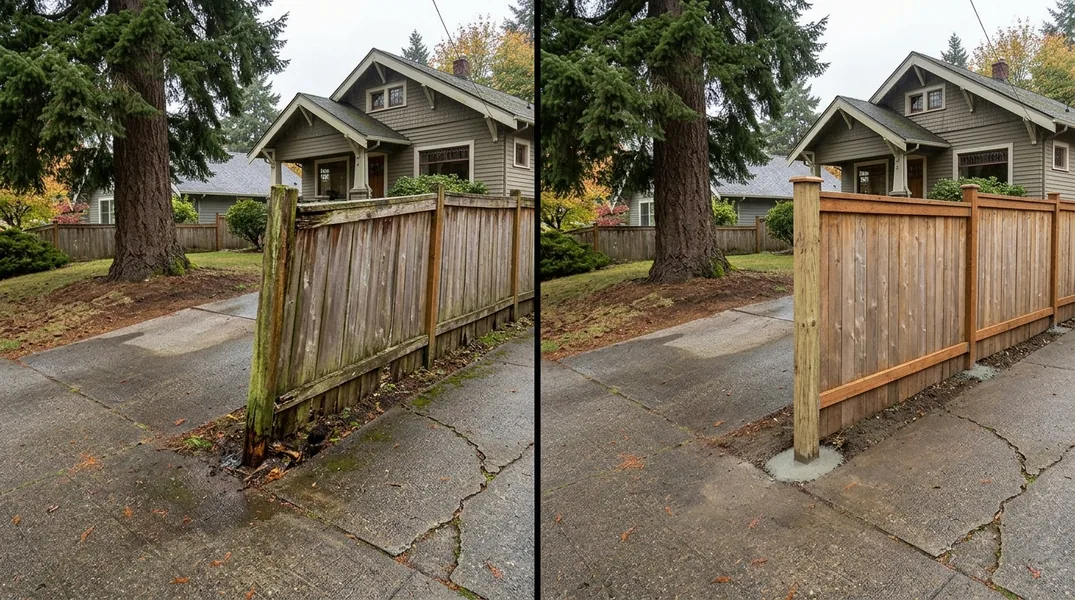
Why Leaning Fences Are So Common in Tacoma
If you drive through neighborhoods in Tacoma, you will notice a familiar sight: a wood fence that lists to one side, sags between posts, or leans farther every season. This is not random. The Pacific Northwest climate creates a specific set of conditions that punish fence posts, and Tacoma sits right in the middle of them. Our wet winters, clay-heavy soils, and occasional dry summer stretches combine to move posts in ways that homeowners in drier parts of the country rarely see.
The core issue is water. When soil stays saturated for months, it loses its grip on the post. A wood post buried in wet ground also absorbs moisture directly, which accelerates decay at the exact point where the post meets the soil. That buried section is the hardest part of the post to inspect and the most likely to fail. By the time a homeowner notices the lean, the damage has usually been developing for one or more seasons. Understanding this cycle is the first step toward fixing it correctly instead of just propping the fence back up.
Wet Soil, Clay, and Frost: What Actually Moves a Post
Tacoma soils often contain a significant clay component. Clay holds water well, which is good for lawns in August and bad for fence posts in January. When saturated clay freezes and thaws, it expands and contracts, and that movement gradually works a post loose in its hole. Even without freezing, repeated wetting and drying cycles cause the soil around a post to settle and shift. A post that was perfectly plumb at installation can develop a noticeable lean within a few years if it was not set deep enough or backfilled with the right material.
There is also the matter of drainage. A fence line that runs along a slope, a downspout outlet, or a low spot in the yard collects more water than the rest of the property. Posts in those locations fail first, which is why leaning fences often have one or two problem posts rather than a uniform tilt. Homeowners sometimes assume the whole fence is failing when the real issue is localized. A professional inspection can tell the difference between a soil problem, a rotted post, and a hardware issue before any money is spent on repairs.
Rotted Fence Post Repair: When You Can Save the Post
Not every leaning post needs to be replaced. If the rot is limited to the very top of the post or to a small area above grade, a rotted fence post repair may be the right call. In these cases, the structural portion below ground is still sound, and the repair focuses on stopping moisture intrusion and restoring the post's strength. This is often the case with posts that were capped properly or that sit under a roof overhang. A qualified installer can probe the post, check for soft wood, and confirm whether the damage is cosmetic or structural.
When rot has reached the buried section, however, patching is not a real fix. A post that is soft below grade cannot hold the fence against wind load, and any repair above ground is temporary at best. Homeowners should be skeptical of anyone who offers to simply brace a badly rotted post without addressing what is underground. The honest answer, in most of these cases, is fence post replacement. Getting that assessment right the first time saves money and prevents the fence from failing again after the next rainy season.
Fence Post Replacement: Doing It Right the First Time
Proper fence post replacement is more involved than pulling out the old post and dropping in a new one. The hole needs to be deep enough to reach below the frost line and below the zone of seasonal soil movement. The new post should be rated for ground contact, and the backfill should be chosen to shed water rather than hold it. Many failing fences in the area were originally installed with posts that were too short, set too shallow, or surrounded by soil that traps moisture. Replacing a post without correcting those conditions just resets the clock on the same problem.
This is where a local installer makes a real difference. A crew that works in Lakewood and University Place every week knows how the soil behaves in this region and how deep posts need to go. If you are searching for fence post repair near me and want the job done once, the right approach is a full assessment of the fence line, not a piecemeal patch. At Tacoma Fence, we inspect the posts, the soil, and the hardware together so the repair actually lasts. You can request a free estimate to get a clear picture of what your fence needs.
Leaning Fence Repair vs. Full Replacement: How to Decide
Sometimes the smartest move is targeted leaning fence repair, and sometimes it is a new fence. The deciding factors are the age of the fence, the number of failing posts, and the condition of the rails and pickets. A ten-year-old fence with two soft posts and sound lumber is a good candidate for repair. A twenty-year-old fence with rot spreading along the bottom rail and several loose posts is usually a candidate for replacement, because repairs will become a recurring expense. A professional can walk the line with you and give you an honest read on both options.
If replacement is the right answer, it is worth choosing materials with the local climate in mind. A Wood & Privacy Fence Installation done with proper post depth and drainage is still the most popular choice for privacy, and modern pressure-treated lumber holds up well when installed correctly. For homeowners who want to skip the rot cycle entirely, Vinyl & PVC Fence Installation is a strong option, and Aluminum & Ornamental Iron Fencing works well for front-yard boundaries that do not need full privacy. Each material has different post and footing requirements, so the installation details matter as much as the panels.
Preventing the Next Lean: Simple Habits That Help
Once a fence is repaired or replaced, a few habits will extend its life. Keep soil graded away from the base of the posts so water drains rather than pools. Avoid piling mulch or soil against the wood, since that holds moisture at the exact spot where rot starts. Check the fence line after heavy winter rains and note any post that feels loose or shows soft wood at the base. Early detection is the difference between a small repair and a full post replacement.
It also helps to know when to call a professional. A fence that leans after a windstorm, a post that moves when you push on it, or visible rot at the soil line are all signs worth acting on quickly. Homeowners in Fircrest and across the Tacoma area can call Tacoma Fence at (253) 319-3547 to schedule an inspection. If you are comparing options, our pricing page outlines typical project ranges so you can plan with confidence. A fence that stands straight for decades is not an accident; it is the result of good installation and a little attention along the way.
Looking for a professional fence contractor in Tacoma? Tacoma Fence responds fast for all your fence needs.
Get a Free Quote